
In the year 1829 a.c. (1545 Coptic), in a village called “Calad” in Egypt, was born the child Paul Gabriel. His parents were righteous and loved God.
He was sent to the Church School. His teacher Rafael took care of him, taught him reading, writing, arithmetic, the Holy Scriptures and psalms, eccliastic hymns and psalmody. He was very intelligent and anxious to learn everything.
When he was eight years old, his mother became very ill, and a few weeks later died, leaving behind a lonely child… As he loved prayers and psalms, he found in it that God can bless his motions and fill all his heart.
When he was fifteen years old, he got famous among his mates; the priests recommended him to “Anba Youssab”, the Bishop of the Diocese, who ordained him as a deacon during his visit to the village’s Church.
As he loved the life of contemplation with God, so he joined St. Virgin Mary Monastery “El-ME-MEHARRAK” at Assuit in Egypt, when Rev. Father Abd-el-Malek was in charge of the monastery. He was very decent, active, and he loved all the monks. They recommended him and he was ordained as a monk when he was nineteen years old, in 1848. His new name was Rev. Paul E1-Meharraki.
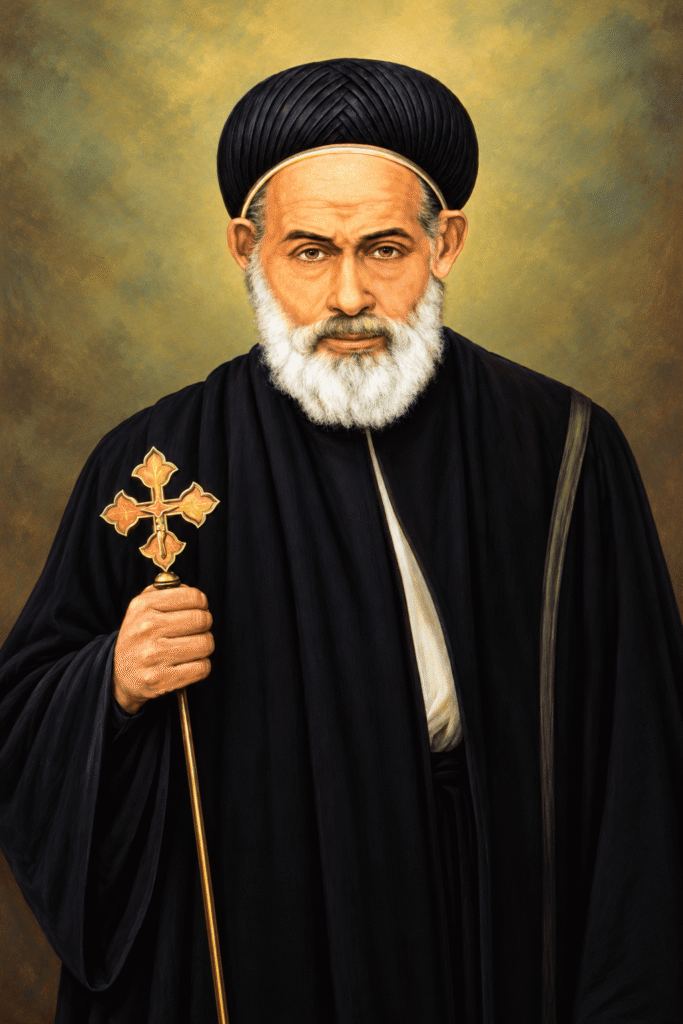
He was distinguished by:
- 1. His patience and self-control.
- 2. His interest in almsgiving
Anba Yakoubos, the Bishop heard about him, he asked him to come to the “Bishop’s house” and to remain with him. Rev. Paul worked day and night, and he changed the “Bishop’s house” to a shelter for the poor.
His deep eagerness for contemplating with God turned him to ask the bishop to leave for the monastery again after he spent four years helping the bishop. Then the Bishop ordained him as a priest and allowed him to return to the monastery at 1863.
At that time there was a problem regarding Father Abdel-Malek, who was in charge of the monastery, but Father Paul did not interfere with these problems .
So the monks chose him to be in charge of the monastery. He opened the doors of the monastery for poor people, also young men heard about him and came, asking him to teach them, and after a short time they became forty monks.
The late “Anba Marcos”, the bishop of Luxor, was ordained as a monk in 1870 at El-Maharrak Monastery and he grew up under the the leadership of Fr. Paul. Pope Kyrillos chose him in 1876 (Coptic) to teach the new monks at El-Baramous Monastery. He met his spiritual father again after five years and he remained with him until 1879 (Coptic) when he was ordained as a Bishop for Luxor. Up till now the people still remember much about his pure life, his holiness, deep love for praying, his modesty, and his special care about everyone, and about renewing the old churches and constructing new ones.
As usual the devil was furious when he saw the monastery opened for the poor, and young people were changed with their love for Jesus and their continuous prayers, and made some of the monks think that Fr. Paul was wasting the money of the monastery and they rebelled against him.
In 1870, Fr. Paul was asked to leave the monastery after being in charge for five years.
He went with four of his students to Cairo to meet “Anba Marcous” the Bishop, and at that time he was acting Pope, and they asked him to go to the Monastery of Anba Bishoy at the “Natroun-Valley” in the western desert of Egypt, where they remained for a short period. Afterwards they went to the next door El-Baramous Monastery in 1871 c. At that time the president of this monastery was Fr. John, who later became “Pope Kyrillos”. he was so glad to receive them and he offered them a place to stay.
Fr. Paul devoted all his time to praying and study…but his deep love for the poor people did not end. He loved the hostile Arabs who were living in the area of the monastery and he shared with them everything he had, even his clothes.
In 1881 the Ethiopian Emperor, John Kassa asked Pope “Kyrillos”, to ordain a metropolitan and three Bishops for the Ethiopian Empire, so he chose the four fathers who were accompanying Fr. Paul,
At the same time Anba Isaac the metropolitan of the province of Fayoum and Gieza departed, then the four fathers asked the Pope to ordain their father as a bishop for that diocese. The Pope and the people of the Fayoum became happy and joyful on that day, for the ordination of their new bishop “ANBA ABRAAM”, in 1881.
During his time, the Diocese of the Fayoum became a great vine, in whose shadow the poor and rich sat with great delight.
When the Khadive Tawfik, Ruler of Egypt, visited El-Fayoum they made a great lunch-party. Anba Abraam was sitting very near to the Khadive. He did not eat except salad, and when the Khadive asked him he answered that the day was Fridays and the Christians are to fast on all Fridays. Then he ordered to bring him fruits and asked Anba Abraam to meet him again. He went to meet him at the railway station before he left, and the Khadive welcomed him deeply saying to him “You are a Blessed man…”
The rulers and governers…, even the tyrannical ones found rest in him. So the simple Bishop’s home became their rest place.
In the year 1893 he was seriously ill with his leg, that the doctors decided to perform surgery to cut off his leg. When one of his spiritual children told him, he smiled, as usual, and said “God will not let it happen. I am sure He will let them down!”
After 2 months he recovered completely, and went out to the Church, praising God. The Bishop’s house was very crowded. The people held the palm leaves and they were waving the olive branches with joy, when they heard of his recovery.
And it happened on Thursday (2 Baouna 1630 c.) 9 June 1914 after the sunset, our blessed father departed to Paradise.
Those who attended his funeral were more than ten thousand persons. Some have estimated it to be twenty five thousand, both Christians and Moslems. But the history of Anba Abraam has not ended, yet still in every Egyptian home there is a lot to be told about him, for he was really God’s loving man.
The Holy Council of Bishops decided that his name could be added with the Saints in the Holy Mass.
The blessing of our blessed Father Anba Abraam be with us. Amen.
Saint Anba Abraam, Bishop of Fayoum and Giza English Translation — The Life of the Saints and Martyrs in the Coptic Orthodox Church Introduction The English writer Mr. Leader heard while he was in France about a holy Egyptian bishop. He quickly traveled to Egypt with his wife to meet him. He later recorded a full chapter about the saint’s life. He wrote that this elderly saint was known throughout the Eastern world and was regarded as a direct successor in the unbroken succession of the early Christians. His wife described their meeting by saying: “We were in the presence of Christ and were filled with the Spirit of God.” His Early Life This saint was born in Galad, belonging to the Diocese of Dairout, in 1829. His parents were pious, and his name was Paul Gabriel. From childhood he memorized the Psalms and studied the Holy Bible. As his heart became inflamed with love for God, he entered the Monastery of the Holy Virgin Mary, Al-Muharraq, where he was tonsured a monk under the name Paul Al-Muharraqi in 1848. When Anba Yacoubos, Bishop of Minya, called him to serve, he transformed the bishopric into a shelter for the poor. He remained there for four years and was ordained a priest in 1863. Because of his love for monastic life, he returned to his monastery, where he was chosen as its abbot. Many young men came to be disciples under his guidance, eventually numbering forty monks. However, because he opened the monastery’s doors wide to the poor and devoted all of the monastery’s resources to the “brothers of Christ,” some people opposed him, removed him from his position, and asked him to leave the monastery. Father Paul and his disciples were expelled because of their love for the poor. They went to the Monastery of the Holy Virgin Mary, Baramos, in Wadi El-Natrun, where he devoted himself to worship and studying the Holy Bible. In 1881, he was consecrated bishop of Fayoum, Beni Suef, and Giza under the name Anba Abraam. He transformed the bishopric into a home for the poor. A Friend of the Poor The bishop dedicated the first floor of his residence to the poor, the blind, and the sick. He would accompany them during their daily meals so that he could personally make sure they were well. Whenever a poor person came to him, he would put his hand under his pillow and give him everything he had. If he found nothing, he would give him his shawl or his outer garment. There are many remarkable stories about his generosity. A Bishopric in Heaven It is reported that the prominent people of the diocese saw that the bishopric building was unsuitable, so they agreed with him to renovate and expand it. Whenever they collected an amount of money, they gave it to him. Finally, they came to him asking him to set a date to meet with the contractor and agree on the building conditions. He looked at them and said: “I have built it, my children! I have built for you a dwelling in the eternal tabernacles.” Taking Advantage of His Compassion Among the stories circulated by people who knew him was the story of three young men who wanted to take advantage of his love for the poor. Two of them entered and claimed that the third had died and that they had nothing with which to bury him. When the bishop asked them, “He died?!,” they answered, “Yes, he died.” The bishop shook his head, extended his hand with a gift, and said, “Take this and shroud him with it.” The two men left laughing, but their laughter soon turned into tears when they discovered that their companion had actually died. A Man of Prayer Many of those who stayed in the room next to his room reported that he would rise at midnight and pray until dawn with the Psalms. He would pause when he reached the words: “Create in me a clean heart, O God, and renew a steadfast spirit within me.” He repeated these words again and again with fervent supplications. Everyone testified that his prayer was filled with spirit and strong determination, even in his old age. Mr. Leader said: “I have never heard a prayer like this in my life. I felt his connection to the throne of grace that fills a person with lasting stability. It seemed to me that the earth had completely disappeared, leaving this man in the very presence of God, speaking with Him clearly.” The source states that hundreds, even thousands, of miracles occurred through this man and through his prayers. His Ascetic Life He was simple in his clothing and food. He lived with only what was necessary and exercised self-control over every desire. One day, he desired to eat chicken, so he asked his disciple to cook it for him. When the food was ready, the disciple served it. The father prayed and asked him to bring it to him the following day. The same thing happened on the second, third, and fourth days, without him eating any of it, until the food spoiled. Then he said to himself: “Eat, O my soul, what you desired.” His Humility Mr. Leader said: “He became uncomfortable when I insisted on kneeling before him.” It was his beautiful custom not to allow any of the deacons to recite the words of honor customarily addressed to a bishop during the reading of the Gospel. Nor did he distinguish himself from his people; he sat on an ordinary chair like the rest of his children. He was pleased when his children called him “Our Father the Bishop,” and he did not allow anyone to call him “Our Lord” or “Our Master.” When Prince Sergius, the uncle of Nicholas, Tsar of Russia, and his wife visited Egypt in 1868 and heard about the saint, they went to visit him. The government arranged an official reception, and prominent Copts tried to purchase new furniture for the bishopric, but he firmly refused. When the two visitors arrived, they knelt on the floor while the father sat praying fervently for them. They presented him with a bag containing a quantity of gold pounds. He declined it and finally accepted only one pound, which he gave to his disciple Rizk. The prince left his presence saying that he had never felt such awe in his life as he did when he stood before the great saint, Anba Abraam. A Bishop Grounded in the Gospel Anba Isidoros said of him that he was knowledgeable in the subjects of the Holy Bible to the point that he had memorized its passages by heart. It was said that he read the Holy Bible once every forty days. Every evening, he gathered his people for prayer together with a study of the Holy Bible. Casting Out Demons The English writer Mr. Leader said: “The bishop’s authority in casting out unclean spirits attracted to him many people from distant places, more than the other gifts for which he was known.” His Departure Shortly before his departure, he summoned Archpriest Abd El-Sayed and some deacons and asked them to pray the Psalms outside his room and not to open the door until half an hour had passed. When they opened the door, they found that the father had departed in the Lord. It is also recorded that on 3 Paoni (1914), Mr. Selim Saib, governor of Fayoum, called to his wife and said, “Ah! It seems that the bishop of the Christians has died. Look at the horses and their riders surrounding him; they are shouting ‘Ekouab, Ekouab.’” He then immediately went and met one of the Christians and asked about the meaning of the word “Ekouab” (eqouab). He was told that in Coptic it means “Holy,” and that it is a hymn of the heavenly beings. His monastery in Fayoum still exists to this day, and his relics there have been a source of blessing to many. The Church decided to proclaim his sainthood at the Holy Synod in 1963, and his feast was celebrated on June 10, 1964. On June 2, 1987, his body was transferred to his special shrine in a chapel at the Monastery of the Virgin Mary, Saint Abu Seifein, and Anba Abraam in Al-Azab. Biography from Another Source The document includes a second account of the saint’s life. It states that he was born in 1829 in the village of Delga, Mallawi District, in the then Governorate of Assiut, to virtuous parents. Anba Yousab, Bishop of Sanbo, ordained him a deacon. When he reached the age of nineteen, he went to the Monastery of the Holy Virgin at Al-Muharraq and was tonsured a monk under the name Paul Gabriel Al-Muharraqi (the monk Paul Gabriel Al-Delgawi Al-Muharraqi), during the leadership of Archpriest Abd El-Malek Al-Hadri, who loved him for his lofty character and severe asceticism. When Anba Yacoubos, Bishop of Minya, heard of his piety, he summoned him, entrusted him with the administration of the bishopric, and assigned him to care for strangers and poor people who sought refuge at the cell. He was later ordained a priest. After some time, he longed for the monastic life and returned to the monastery. The monks loved him and asked for their abbot to be removed. During his leadership, the monastery prospered: he planted a vineyard, repaired what had been destroyed, and purchased lands, causing many people to embrace monasticism. He eventually tonsured forty monks at one time and remained in service to the monastery for five years. He spent generously on the poor and needy. The monks warned him that the monastery would be ruined if he continued in this way, but he persisted. Eventually, the number of poor people became greater than the number of monks, so the monks requested that he be removed. Anba Markos, Bishop of Beheira, who was acting on behalf of the Patriarch, agreed to remove him. He left the monastery while the needy wept for him. Some of his faithful disciples accompanied him to the Patriarchate, including Anba Mattheos, Bishop of Ethiopia. He was later sent to the Monastery of Anba Bishoy, where he was welcomed into a cell. He and the monks studied the Holy Bible together until he memorized most of its passages, since he read it once every forty days. In 1888 AD / 1597 AM, he was chosen as Bishop of Fayoum under the name Anba Abraam, and his holiness became widely known. The people around him were primarily the poor and needy. He made most of the bishopric residence a shelter for them, sat with them, spent everything he had on them, and would not eat except with them. He appointed a monk to serve them. The source then relates an episode involving the servant, who was dismissed after neglecting the cooking; she subsequently suffered paralysis. The account continues with many stories of his assistance to the poor and miracles that, according to the source, God performed through him. Anba Abraam continued carrying out the responsibilities of the diocese until illness overtook him in Bashans 1630 AM. His illness became severe, yet he remained patient in his suffering. He desired stuffed pigeons and considered this his final test. He ordered them to be prepared, left them until they spoiled, placed them before himself, and spoke to his soul: “I have answered your request, O my soul. Eat what you will eventually become like.” He then threw the food away. Anba Abraam departed in the month of Paoni, 1630 AM / June 10, 1914, and was buried in his tomb at the Church of Abu Seifein. Sources Listed in the Original Document • History of the Coptic Church from the 10th to the 19th Century — Dr. Yacoub Rizk. • T. Y. Malaty, “Anba Abraam, the Friend of the Poor,” Alexandria, 1974. • “The Church’s Lyre” — Anba Benjamin, former Bishop of Menoufia; Amir Nasr, November 1993. Translation note: The original document contains two biographical accounts and some differences in details (including the stated birthplace and chronology). Those differences have been retained rather than reconciled or silently corrected.
